
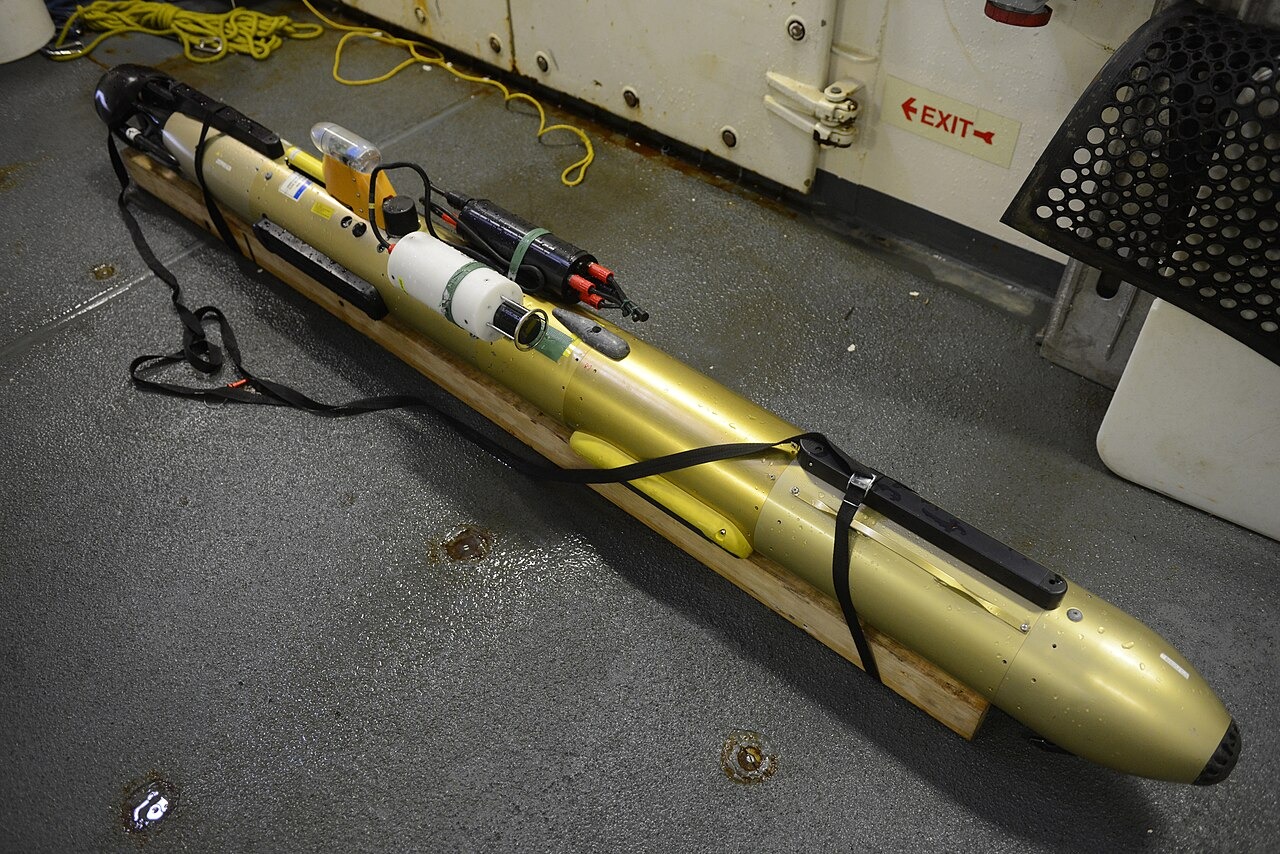
Euroatlas has exhibited a production version of its Greyshark autonomous underwater vehicle at Euronaval 2026, marking a shift from a technology demonstrator toward customer deliveries. EDR Magazine reports that two undisclosed nations have signed contracts and that the first vehicles are expected to be delivered by the end of 2026; this is a production and delivery milestone, not evidence that the system has entered operational service.
The most visible change is propulsion. The prototype used one shrouded rear propeller, but the production configuration has two counter-rotating motor pods mounted on the sides. EDR reports that the redesign addresses roll during acceleration and enables yaw control through differential motor speed. Separate bow and aft trim systems control pitch, allowing the vehicle to remain manoeuvrable even if its rudders and dive planes are lost. The twin-motor arrangement also provides single-engine redundancy, according to the report.
EDR says the redesigned vehicle is lighter and carries twice the prototype’s battery capacity, with a stated ability to achieve more than 320 nautical miles at four knots with a full payload. It gives a 10-knot transit cruise speed, a 14-knot dash speed and an operational cruise speed of about eight knots or lower when sonar and mission demands are included. The vehicle’s 17 onboard sensors are intended to support intelligence, surveillance and reconnaissance, anti-submarine warfare, mine countermeasures and marine critical-infrastructure surveillance. The exact battery technology was not disclosed.
Control and maturity remain important limits. The Greyshark’s software was developed partly through the earlier demonstrator, which Euroatlas used at the NATO-backed REPMUS experimentation exercises, but the report does not specify how mission decisions are supervised or how communications loss is handled. That distinction is visible elsewhere in the underwater-vehicle sector: Naval News reports that Naval Group’s French UCUV is still an operational demonstrator, with human-supervised autonomous operations and sea trials planned for 2028. Greyshark’s production status therefore indicates a more advanced manufacturing phase, not proof of comparable autonomy, combat effectiveness or fleet deployment.