
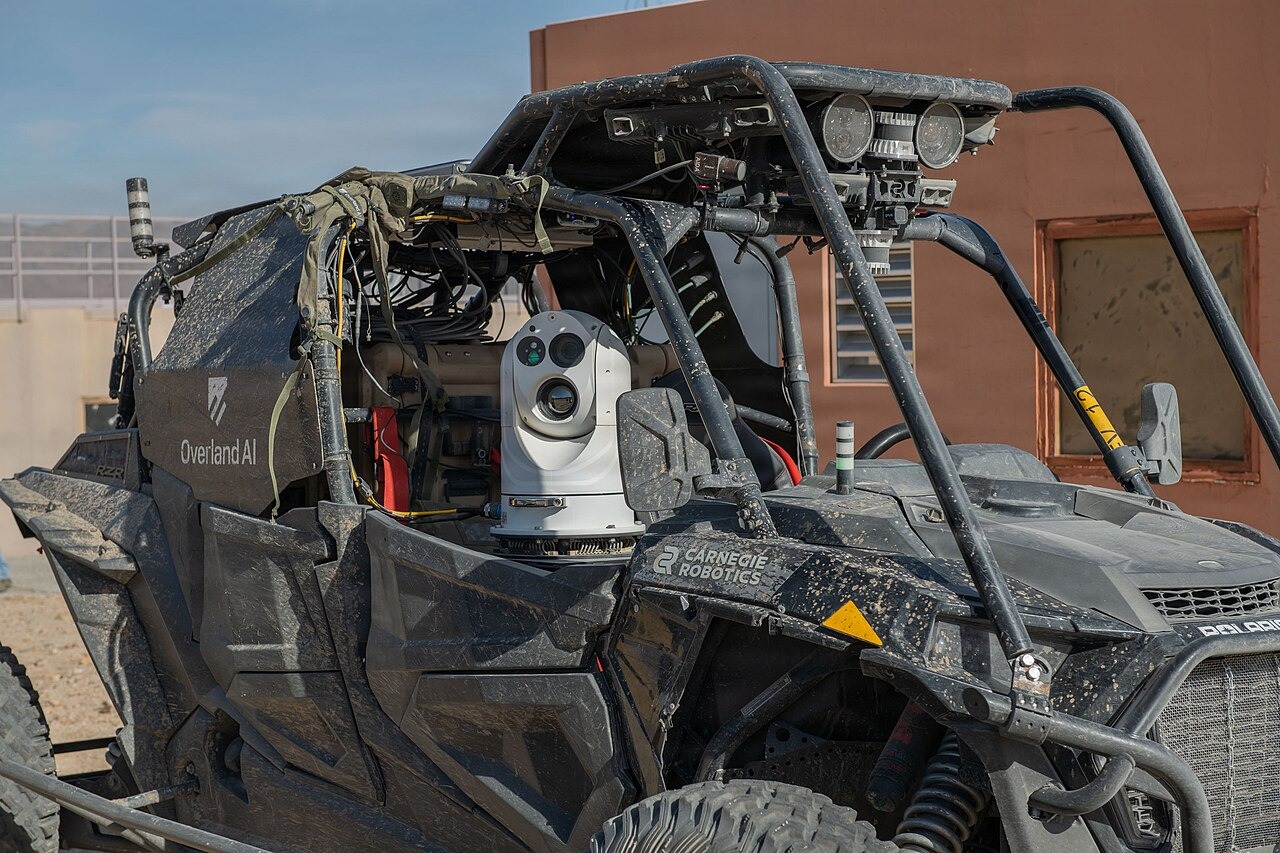
Four autonomous unmanned ground vehicles developed under DARPA’s Robotic Autonomy in Complex Environments with Resiliency (RACER) program demonstrated coordinated off-road movement and target detection at Fort Knox, Kentucky, in an exercise reported by DVIDS.
The October 15 demonstration used satellite imagery to alert an operator to a simulated threat. The operator then tasked the robotic team, sending one vehicle along a road while the others initially held position before moving to provide support. The lead vehicle used onboard sensors to traverse the terrain, detected a potential target and stopped while awaiting further instruction. A simulated rocket subsequently struck a target about 300 yards away.
DARPA technical adviser Jason Gregory told DVIDS that the system can accept a ten-digit grid for a traversable mobility corridor, interpret terrain with its onboard sensors and drive there in a manner comparable to a human driver. The report said the vehicles’ mobility, movement and target detection were autonomous, but engagement decisions were not: a human received information from detected targets and had to approve any engagement.
The control boundary fits RACER’s broader design. In a DARPA account of the program, the agency describes RACER as an autonomy stack of algorithms, datasets and neural-network models that can be applied to suitably equipped ground vehicles. DARPA says the stack is intended to support off-road operation without GPS or pre-mapped routes, while its perception architecture adapts to unfamiliar and ambiguous terrain.
The Fort Knox event was an end-to-end test linking satellite imagery to tactical ground operations, rather than evidence of an operationally deployed combat system. The reported targets and rocket strike were simulated, and the account does not establish a production decision or regular fielding. DARPA officials said the next test was expected in December, when soldiers would provide feedback on how the vehicles should be used.